




Someone tried to explain machine learning to me. I was at a dinner party, and this guy who worked at some tech company started talking about how machines could “learn” from data. And I remember thinking, “That’s ridiculous. Machines don’t learn. They just do what we program them to do.”
I said that out loud. Right there in front of everyone. With a bagel in my hand and a kind of smug confidence that I now look back on with absolute cringe.
And the guy just smiled and said, “Actually, that’s exactly what machine learning is. We don’t program them. They figure it out themselves.”
My stomach dropped. I felt this heat rising up my neck because I’d just publicly shown my ignorance. I mumbled something about needing another drink and retreated to the corner, feeling about two inches tall.
But you know what? That guy was right. And I was wrong. And that moment of embarrassment, uncomfortable as it was, ended up being the thing that finally pushed me to actually understand what machine learning really is.
Here’s the thing. Machine learning is everywhere now. It’s in your phone. It’s in your email. It’s in your streaming services. It’s in your bank’s fraud detection systems. It’s in the medical scans your doctor looks at. It’s basically unavoidable.
And yet, most of us have no idea what it actually means. We use the term “machine learning” the way we use “quantum physics” or “cryptocurrency,” like something vaguely impressive that we’re not quite sure about and don’t really want to admit we don’t understand.
I’ve been there. I spent years nodding along when people mentioned machine learning, secretly hoping nobody would ask me to explain it. And when they did, I’d change the subject as quickly as possible, usually by asking about their weekend or complimenting their shoes.
But here’s the thing I eventually figured out. Machine learning is actually one of the simplest concepts in all of AI once you strip away the jargon. It’s just a different way of getting computers to do things. Instead of telling them exactly what to do, we show them examples and let them figure it out.
That’s it. That’s the whole secret.
So let me walk you through what I’ve learned. Not as an expert, but as someone who was just as confused, just as intimidated, and just as afraid of looking stupid as you might be right now. I want to give you the explanation I wish someone had given me all those years ago at that dinner party.
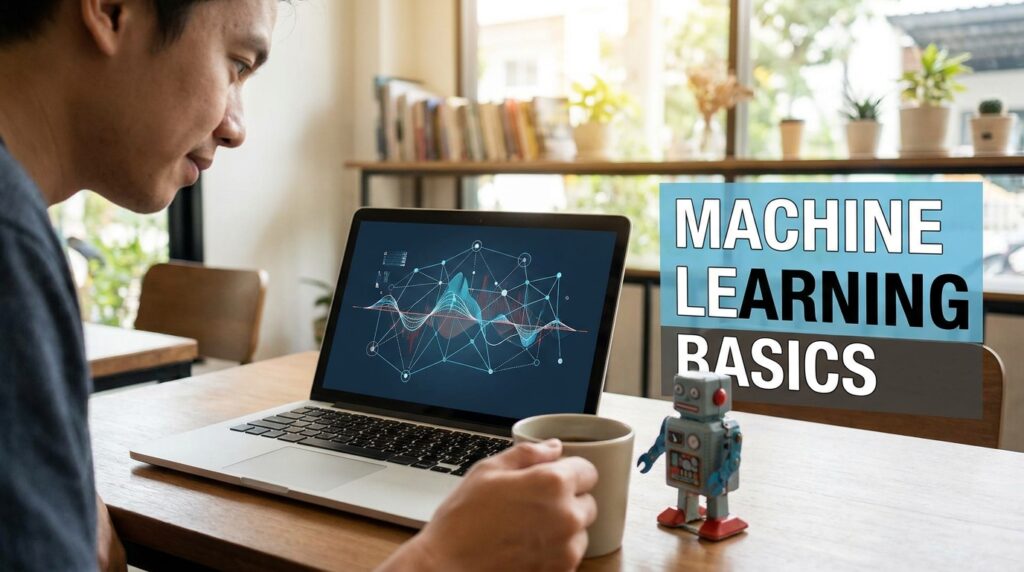
Why Machine Learning Feels So Confusing
Let’s talk about why machine learning is so hard to wrap your head around.
Part of the problem is the name itself. “Machine learning.” It sounds like the machine is actually learning the way a human learns. Like it’s sitting in a classroom, taking notes, doing homework, maybe even getting a report card.
And that’s not what’s happening at all. The machine isn’t learning in any meaningful sense. It’s not understanding. It’s not gaining wisdom. It’s not becoming more intelligent. It’s just… adjusting. Tweaking. Optimizing. It’s finding patterns and getting better at predicting things.
But “machine adjusting” doesn’t sound as impressive, does it? So we call it “learning” because it makes it sound more exciting and also more threatening. And that confusion, that misleading name, makes everything harder to understand.
Another big source of confusion is that machine learning is fundamentally different from traditional programming. And most of us have at least some idea of what traditional programming is, even if we don’t code ourselves. We know that programmers write instructions. They tell the computer exactly what to do. If this, then that. Do X, then Y, then Z.
Machine learning flips that completely on its head. Instead of writing instructions, you give the computer data and let it write the instructions itself. You don’t tell it how to recognize a cat. You show it thousands of cats and let it figure out the pattern on its own.
That’s a completely different way of thinking about computers. And it takes time to wrap your head around it.
Then there’s the technical language. “Neural networks.” “Training data.” “Supervised learning.” “Unsupervised learning.” “Reinforcement learning.” It’s all so dense and opaque. It feels like you need a degree in computer science just to understand the vocabulary.
And finally, there’s the intimidation factor. Machine learning has become this almost mythical concept. We hear about it constantly, usually attached to some incredible achievement or some terrifying prediction. It’s portrayed as either the savior of humanity or its destroyer. And that makes it feel huge and incomprehensible.
But here’s what I’ve come to realize. Machine learning is actually quite simple at its core. The basic idea is straightforward. The details can get complex, sure. But the fundamental concept is something anyone can understand.
Let me show you.
But Here’s What I Figured Out…
The question that finally unlocked machine learning for me was actually about babies.
Think about how a baby learns to recognize their parent’s face.
Nobody gives the baby a list of features. Nobody says, “Okay, the nose is this shape, the eyes are this color, the hair is this texture.” That would be ridiculous. The baby just sees their parent’s face over and over, in different lighting, from different angles, at different times of day. And gradually, the baby’s brain figures out the pattern. It learns what makes that face unique.
That’s machine learning. Not in the literal sense, obviously, babies are not computers. But the underlying principle is the same. Instead of being programmed with explicit instructions, the system learns from examples. It sees patterns and generalizes from them.
Another analogy that helped me is cooking.
Imagine you’re trying to teach someone to make a perfect omelet. You could give them a recipe with exact measurements and step by step instructions. That’s traditional programming. You’re giving explicit directions.
But imagine instead that you just made omelets over and over while they watched. You made them with different ingredients. You made them with different techniques. You burned a few. You undercooked a few. And then you had them start making omelets themselves, learning from the examples you showed them.
That’s machine learning. The “learner” isn’t getting explicit instructions. They’re figuring out the pattern from examples.
The trick with machine learning, and this is where the analogy falls apart a bit, is that the machine doesn’t actually understand anything. It’s not learning the way a human learns. It’s not gaining insight. It’s just adjusting mathematical parameters based on the data it’s been given.
But the core concept is the same. Learning from examples instead of following explicit instructions. That’s machine learning.
Once I understood that, everything else started to make sense. The fancy terms. The complicated explanations. It all came back to that simple idea. Show the computer lots of examples and let it figure out the patterns.
What Machine Learning Actually Is
Let me give you the simplest possible definition.
Machine learning is a way of teaching computers to do things without explicitly programming them. Instead of writing rules, you give the computer data and let it discover the rules on its own.
Here’s the traditional programming approach. You write code that tells the computer exactly what to do. If you want it to filter spam, you write rules. “If the email contains the word ‘Viagra,’ mark it as spam.” “If the email is from an unknown sender, mark it as spam.” You’re telling the computer exactly what to look for.
And this works, up to a point. But it breaks down when the problem is too complex for a human to write rules for. How do you write rules for recognizing a cat? What features do you look for? The shape of the ears? The pattern of the fur? The way it moves? There are so many variations that writing explicit rules is basically impossible.
Machine learning takes a different approach. Instead of writing rules, you gather a huge number of examples. You give the computer thousands of pictures of cats and thousands of pictures of not-cats. And you let the computer figure out the patterns on its own.
The computer analyzes all those pictures and discovers what makes a cat a cat. It’s not following rules that a human wrote. It’s finding the patterns itself.
That’s the key difference. Traditional programming is human driven. A human decides what the rules should be. Machine learning is data driven. The computer discovers the rules from the data.
This is why machine learning is so powerful. It can solve problems that are too complex for humans to program. It can find patterns that humans might not even know exist. It can adapt to new situations in ways that traditional programs can’t.
And it’s also why machine learning can be dangerous. Because if the data is biased, the machine learns biased patterns. If the data is incomplete, the machine learns incomplete patterns. If the data is wrong, the machine learns wrong patterns.
The machine is only as good as the data it’s trained on. That’s a crucial limitation to understand.
The Different Types of Machine Learning
Not all machine learning is the same. There are different approaches for different problems. Let me break down the main categories.
Supervised Learning
This is the most common type of machine learning. It’s called “supervised” because the training data comes with labels. You’re supervising the learning by telling the computer what each example is.
Imagine you’re teaching a child to recognize animals. You show them a picture and say, “That’s a dog.” You show them another picture and say, “That’s a cat.” You do this over and over until the child can identify animals on their own.
Supervised learning is exactly the same. You give the computer a dataset where each example is labeled. Here’s a picture of a cat, and it’s labeled “cat.” Here’s a picture of a dog, and it’s labeled “dog.” Here’s an email that’s spam, and it’s labeled “spam.”
The computer analyzes all these labeled examples and learns the patterns. Then, when you give it new, unlabeled data, it can make predictions. It can tell you whether a new picture is a cat or a dog. It can tell you whether a new email is spam or not.
Supervised learning is used for things like image recognition, spam detection, medical diagnosis, and fraud detection. Any situation where you have labeled training data and you want to make predictions on new data.
Unsupervised Learning
Unsupervised learning is different. Here, the training data doesn’t have labels. The computer has to find the patterns on its own.
Imagine you’re given a huge pile of photographs with no labels. You have no idea what’s in them. But you start grouping them together based on similarities. You put all the ones that look like landscapes together. You put all the ones with faces together. You put all the ones with text together. You’re finding patterns without any guidance.
That’s unsupervised learning. The computer looks at the data and finds patterns, groups, and structures on its own. It doesn’t have any labels telling it what to look for. It just explores the data and discovers what’s there.
Unsupervised learning is used for things like customer segmentation, anomaly detection, and data compression. It’s useful when you don’t know what patterns might exist in your data and you want the computer to find them for you.
Reinforcement Learning
Reinforcement learning is a third type. It’s based on the idea of trial and error, with rewards and punishments.
Think about training a dog. When the dog does what you want, you give it a treat. When it does something wrong, you give no treat or a mild correction. Over time, the dog learns what behaviors lead to treats and what behaviors don’t.
Reinforcement learning is similar. The computer takes actions in an environment and gets rewards or punishments. It learns to take actions that maximize its rewards and avoid actions that lead to punishments.
This is how AI learns to play games. It tries different moves, sees what works, and gradually gets better. It’s also used in robotics, self driving cars, and automated trading systems.
Self-Supervised Learning
This is a newer approach that’s been getting a lot of attention. It’s like supervised learning, but the labels are generated automatically from the data itself.
Imagine you’re reading a book with a word missing on every page. Your job is to guess what the missing word is. You can do this because you understand the context and the patterns of language.
Self-supervised learning works the same way. The computer is given data with some parts missing. Its job is to predict the missing parts. In doing so, it learns the patterns and structures in the data.
This is how large language models like ChatGPT are trained. They’re given millions of pages of text with some words masked out. They learn to predict the missing words, and in the process, they learn the structure and patterns of language.
The Machine Learning Process: Step by Step
Let me walk you through how machine learning actually works in practice. Step by step.
Step One: Define the Problem
First, you need to know what you’re trying to achieve. Are you trying to classify something? Predict something? Generate something? The type of problem determines the type of machine learning approach you’ll use.
This seems obvious, but it’s surprisingly easy to get wrong. You need to be clear about what you want the machine to do.
Step Two: Gather and Prepare Data
This is the most important step. Your model is only as good as your data. If you feed it garbage, it learns garbage patterns.
You need to gather a large, diverse, and representative dataset. You need to clean it. You need to remove errors. You need to handle missing values. You need to make sure the data is balanced and not biased.
This step takes the most time. It’s also the most important. Data is the fuel that powers machine learning. Without good data, nothing else matters.
Step Three: Choose a Model
Next, you choose the type of model you’re going to use. Different models are good at different things. Some are better at recognizing images. Others are better at understanding language. Others are better at making predictions.
The choice of model depends on your problem, your data, and your resources. Some models are simple and fast. Others are complex and powerful. You need to find the right balance.
Step Four: Train the Model
Now you feed your training data to the model and let it learn. The model processes the data, finds the patterns, and adjusts its parameters accordingly.
This is where the actual “learning” happens. The model goes through the data over and over, getting a little better each time. It’s like studying for a test. The more you study, the more you learn.
Step Five: Evaluate the Model
Once the model is trained, you test it on data it hasn’t seen before. This is called “validation.” You want to see how well the model performs on new data.
If it performs well, great. If it performs poorly, you go back and make adjustments. Maybe you need more training data. Maybe you need a different model. Maybe you need to change how the data is prepared.
Step Six: Deploy and Monitor
Once the model is performing well, you deploy it. You make it available for real world use. People give it inputs and it generates outputs.
But you don’t stop there. You monitor the model’s performance. You watch for signs of degradation. You update it with new data as it becomes available. You keep improving it over time.
This is an ongoing process. Machine learning models aren’t static. They need maintenance and attention.
What Machine Learning Is Good At
Let me give you a sense of what machine learning actually excels at.
Pattern Recognition
Machine learning is amazing at finding patterns in data. It can detect subtle correlations that humans might miss. It can find connections across millions of data points.
This is why machine learning is used for medical diagnosis. It can spot early signs of disease in medical images that human doctors might overlook. It can identify patterns in patient data that suggest a particular diagnosis.
Prediction
Machine learning is excellent at making predictions based on past data. It can forecast weather, predict stock prices, anticipate customer behavior, and estimate demand for products.
It’s not perfect. Predictions can be wrong. But machine learning can often make better predictions than humans, especially when there’s a lot of data to analyze.
Automation
Machine learning can automate tasks that would normally require human intelligence. It can read documents, answer questions, recognize speech, translate languages, and generate content.
This is what makes machine learning so disruptive. It can do things that only humans could do before, and it can do them faster and cheaper.
Personalization
Machine learning can tailor experiences to individual users. It recommends movies you might like, products you might want, and articles you might find interesting.
It does this by analyzing your behavior and comparing it to the behavior of others. It finds patterns in what you like and uses those patterns to predict what else you might like.
The Limitations: What Machine Learning Can’t Do
It’s equally important to understand the limitations of machine learning. It’s not magic. It has real constraints.
It Doesn’t Understand
Machine learning doesn’t understand anything. It doesn’t know what a cat is, even if it can recognize one. It doesn’t know what language is, even if it can generate text. It doesn’t understand the world. It just finds patterns in data.
This is a crucial limitation. The machine is not thinking or reasoning. It’s just matching patterns. It doesn’t have common sense. It doesn’t understand context. It doesn’t grasp nuance.
It’s Biased
Machine learning inherits the biases in its training data. If your data is biased, your model is biased. If your data is missing certain populations or perspectives, your model will perform poorly for those populations.
This is a serious ethical problem. Machine learning models can perpetuate and amplify existing biases. They can make decisions that are unfair or discriminatory.
It Can’t Explain Itself
Machine learning models are often “black boxes.” They can produce answers, but they can’t always explain why they produced those answers. The patterns they’ve discovered might be opaque even to their creators.
This is a problem for accountability. If a model makes a bad decision, you might not be able to understand why. You might not be able to fix the problem.
It’s Fragile
Machine learning models can be surprisingly brittle. They perform well on the data they were trained on, but they can fail spectacularly on data that’s slightly different. A small change in the input can lead to a completely wrong output.
This is a problem for reliability. You can’t always trust a model to perform well in unexpected situations.
But What If You’re Thinking…?
“This all sounds really complicated. I don’t think I can understand it.”
I felt exactly the same way. For years, I told myself that machine learning was something only geniuses could understand. I convinced myself it was beyond my capabilities.
But here’s what I eventually realized. The basics of machine learning are actually quite simple. The core concept is straightforward. It’s just wrapped in jargon and technical language that makes it seem harder than it is.
You don’t need to understand the math. You don’t need to understand the algorithms. You just need to understand the basic idea. And that’s something anyone can grasp.
“Is machine learning the same as AI?”
No, but they’re related.
AI is the broader field. It’s all about creating machines that can do things that normally require human intelligence. Machine learning is one approach to AI. It’s a specific way of achieving intelligence by learning from data.
Think of it this way. AI is the goal. Machine learning is one method for achieving that goal. There are other methods too. But machine learning is by far the most successful and widely used.
“Why is machine learning so popular right now?”
Two reasons. Data and computing power.
We have more data than ever before. Billions of images, trillions of words, endless streams of information. And we have computers powerful enough to process all that data. Machine learning needs both. The more data and processing power you have, the better machine learning works.
We’re living in a golden age for machine learning. The ingredients are all there. And the technology is advancing faster than anyone predicted.
Where to Go from Here
Okay, take a breath. Let all of this settle.
I remember that dinner party so clearly. The heat rising up my neck. The smug confidence that turned into immediate embarrassment. The feeling of being exposed as someone who didn’t know what they were talking about.
But you know what? That moment, uncomfortable as it was, ended up being the best thing that could have happened. Because it forced me to actually learn. It pushed me to understand something I’d been pretending to understand for years.
And now, when someone asks me what machine learning is, I can actually tell them. Not with technical jargon or complicated explanations. Just the simple truth. It’s teaching computers to learn from examples instead of following explicit instructions.
That’s it. That’s all it is.
You don’t need to be a computer scientist. You don’t need to understand the math. You don’t need to build models yourself. You just need to understand the basic concept, the core idea that makes all of this possible.
And now you do.
So here’s my recommendation. Take what you’ve learned here and pay attention to the machine learning happening around you. Notice when Netflix recommends a show. Notice when your email filters spam. Notice when your phone recognizes your face. Notice when a website suggests a product you might like.
All of that is machine learning. And now you understand what’s happening behind the scenes. Not perfectly. Not completely. But enough. Enough to have a real understanding. Enough to feel less intimidated. Enough to join the conversation.
You’ve got this. And I’m cheering for you.
This is just the beginning of your machine learning journey. If you found this helpful and want to go deeper, let me know what questions are still knocking around in your head. I’ve got more to share, and honestly, this stuff becomes more fascinating the more you dig into it. One step at a time, friend.

Other Articles

AI Skills That Can Help Students Get Jobs
What Is an AI Model? Explained in Simple Terms