




I’ll never forget the first time someone tried to explain what an “AI model” actually is. I was at a conference, standing by the coffee station, and this guy in a hoodie started talking about “neural network architectures” and “parameter weights” and “training data distributions.”
And my brain just… shut down.
Like, completely shut down. The kind of shutdown where you’re nodding along but all you can hear is the buzzing of the fluorescent lights and the pounding of your own heartbeat in your ears.
I’m guessing you’ve had moments like that too. Maybe you’ve heard people talk about AI models and you just smiled and nodded, hoping nobody would notice you had absolutely no idea what they were talking about.
Here’s the embarrassing truth about me. I spent months using ChatGPT, generating images with Midjourney, playing with all these AI tools, and I couldn’t have told you what an “AI model” actually meant if my life depended on it.
It was like driving a car every day but having no idea how the engine worked. It got me where I needed to go, sure. But when something went wrong, I was completely helpless. And when people started talking about different models and why one was better than another, I was totally lost.
I remember this one specific moment that really drove it home. My friend, who works in tech, was raving about some new AI model that had just been released. He was going on about how much better it was than the previous one, how it had more parameters, how it was trained on more data.
And I just sat there with this knot in my stomach, smiling and nodding, thinking, “I don’t even know what a parameter is. I don’t know what training means. I don’t know why any of this matters.”
That night, I went home and did something I should have done months earlier. I Googled “what is an AI model” and I started reading. Not technical papers. Not dense academic articles. Just simple explanations. The kind of stuff a regular person could actually understand.
And you know what I discovered?
It’s not nearly as complicated as it sounds. The concept is actually pretty straightforward. It’s just wrapped in so much jargon and tech speak that it feels like you need a computer science degree just to understand the basics.
So let me do for you what nobody did for me. Let me explain what an AI model actually is, in simple terms, without all the pretentious garbage. Just a friend sitting across from you, breaking it down the way I wish someone had broken it down for me.
Why “AI Model” Sounds So Intimidating
Let’s be honest. The word “model” is confusing all by itself.
When you hear the word “model,” what do you think of? Maybe a fashion model. Maybe a scale model of a building. Maybe a mathematical model from high school that you’ve tried very hard to forget.
None of those help you understand what an AI model is. So you’re already starting from a place of confusion. And then people start throwing around words like “neural networks” and “deep learning” and “transformers” and your eyes just glaze over.
I’ve been there so many times. It’s like everyone else is speaking a language you don’t know, and you’re too embarrassed to ask what anything means because you don’t want to look stupid.
The other problem is that “AI model” gets used to describe so many different things. ChatGPT is an AI model. Stable Diffusion is an AI model. The spam filter in your email is an AI model. They’re all called the same thing, but they work differently and do different things.
So even if you figure out what one model is, you’re still confused about what they all have in common. What makes something an “AI model” versus just regular software? Where’s the line?
And then there’s the mystery factor. AI models feel like magic. You type something in and something comes out, and you have no idea what happened in between. It’s like a black box. And when something feels like magic, it’s easy to assume you’ll never understand it.
But here’s the thing. Magic is just science we haven’t learned yet. And once you know the basic idea, the magic disappears and you’re left with something you can actually work with.
So let’s demystify this together.

But Here’s What I Figured Out…
The question that finally unlocked this for me was actually pretty simple. “What is a model, really?”
And the answer, stripped of all the fancy jargon, is this. A model is a simplified version of something real.
Think about a model airplane. It’s not a real airplane. It can’t fly. It doesn’t have an engine. But it looks like an airplane. It has the right shape. It gives you a sense of what a real airplane is like.
An AI model is kind of like that. It’s a simplified version of something real, in this case, human intelligence. It’s not actually intelligent. It’s not conscious. It doesn’t think. But it mimics certain aspects of intelligence. It looks like thinking. It acts like thinking. And for certain tasks, it works like thinking.
But here’s where the analogy breaks down a little. An AI model isn’t physical like a model airplane. It’s information. It’s a set of patterns that have been learned from data and stored in a computer.
Think of it like a recipe.
A recipe isn’t the food itself. It’s instructions for how to make the food. It tells you what ingredients to use, how much of each, what order to combine them in, how long to cook them.
An AI model is kind of like a recipe for generating outputs. It tells the computer how to take an input, like a question or a prompt, and produce an output, like an answer or an image.
But here’s the difference. A recipe is written by a human who understands cooking. An AI model is learned automatically from data. The computer figures out the “recipe” on its own by looking at millions of examples.
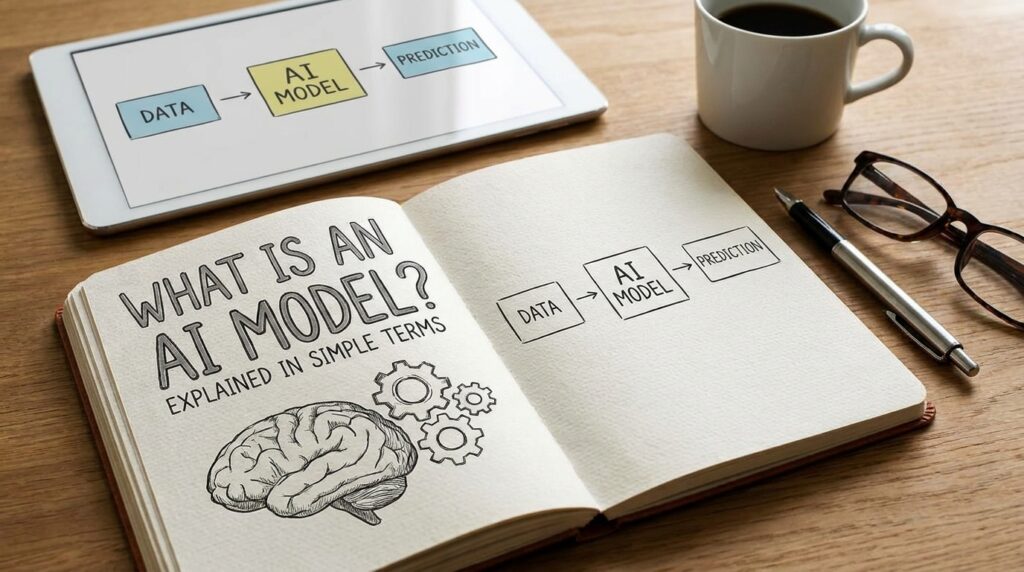
That’s the key insight. An AI model is a set of patterns that a computer discovered by analyzing massive amounts of data. Those patterns allow it to make predictions, generate text, recognize images, and do all the other things we call AI.
Once I understood that, everything else started to make sense.
What an AI Model Actually Is
Let me give you the simplest possible definition.
An AI model is a mathematical representation of patterns found in data. It’s a way for a computer to store and use what it has learned.
When you train an AI model, you feed it tons of examples. If you want it to recognize cats, you show it millions of pictures of cats. If you want it to write text, you feed it billions of words. The computer analyzes all that data and finds the patterns.
Then it stores those patterns in a way that’s efficient and useful. This stored information, these patterns, that’s the model.
Now, here’s the important part. The model isn’t the data itself. It’s not a database of all the pictures you showed it or all the text you fed it. It’s something much smaller and more abstract.
Think of it like this.
If you read a hundred romance novels, you don’t memorize every sentence. But you do learn the patterns. You learn how love stories are structured. You learn what characters tend to be like. You learn how conflict gets resolved. You learn the rhythms of romantic dialogue.
The model is like that knowledge. It’s not the books themselves. It’s everything you learned from reading them.
That’s why an AI model can generate new things it’s never seen before. It’s not copying. It’s using the patterns it learned to create something new that fits those patterns.
When ChatGPT writes a response, it’s not pulling from a database of pre written answers. It’s using its patterns to generate new text that fits what you asked for. It’s like you writing a new story in the style of the romance novels you read. You’re not copying any specific book. You’re just following the patterns you learned.
That’s the magic. And that’s also the limitation. Because the model is only as good as the data it was trained on. If you feed it garbage, it learns garbage patterns. If you feed it biased data, it learns biased patterns. If you feed it outdated data, it learns outdated patterns.
The model is a reflection of its training. Nothing more, nothing less.
How AI Models Are Different from Regular Software
This is something that confused me for a long time. What makes an AI model different from just… regular computer code?
Here’s the distinction that finally made it click for me.
Regular software is programmed. A human writes explicit instructions. If this, then that. Do X, then do Y, then do Z. The computer follows those instructions exactly. It does exactly what it’s told, no more, no less.
An AI model is learned, not programmed. Instead of writing instructions, you give the computer data and let it figure out the instructions on its own. You don’t tell it how to recognize a cat. You show it thousands of cats and it figures out the pattern.
This is why AI can do things that would be almost impossible to program manually. How would you write explicit instructions for recognizing a cat? What features would you look for? The shape of the ears? The pattern of the fur? The way it moves? There are so many variations that writing explicit rules would be basically impossible.
But show a computer enough examples, and it can figure out the pattern on its own.
This is also why AI can sometimes do things that surprise us. Because the computer discovered patterns we didn’t even know existed. It learned things we couldn’t have taught it, because we didn’t know them ourselves.
That’s the power. And it’s also the risk. Because if the computer learned patterns we didn’t know about, we might not know what it’s actually doing. We might not understand why it made a particular decision. We might not be able to explain its behavior.
That’s the “black box” problem people talk about. And it’s a real concern.
The Different Types of AI Models
Not all AI models are the same. Different models are designed for different tasks. Let me break down the main categories.
Language Models
These are models that understand and generate human language. ChatGPT is the most famous example. It’s been trained on billions of words and can have conversations, write articles, translate languages, and do all kinds of other language based tasks.
Language models work by predicting the next word in a sequence. They take the words you’ve given them and calculate which word is most likely to come next. Then they do it again. And again. And again.
That’s why they’re sometimes called “autocomplete on steroids.” Because that’s basically what they are. Just really, really advanced autocomplete.
Image Models
These models generate or recognize images. DALL-E, Midjourney, and Stable Diffusion are all image generation models. You give them a text prompt, and they create an image that matches it.
Image models work differently from language models. Instead of predicting the next word, they’re predicting the next pixel. They start with random noise and gradually refine it into a recognizable image.
They’re also used for image recognition. When your phone identifies a face in a photo, it’s using an image model that’s been trained to recognize faces.
Multimodal Models
These are the new generation of AI models that can handle multiple types of input and output. They can understand text, images, audio, and sometimes even video.
Some models can look at an image and describe what’s in it. Others can listen to audio and transcribe what’s being said. Others can generate images from text descriptions.
These models are more versatile and powerful than single purpose models. They’re also more complex and require more training data.
Specialized Models
There are also AI models designed for specific tasks. Models for medical diagnosis. Models for financial prediction. Models for game playing. Models for robotics.
These models are trained on specialized data and optimized for their specific domain. They’re often more accurate and reliable than general purpose models for their specific task, but they can’t do much else.
Why the Size of a Model Matters
You might have heard people talk about “parameters” when discussing AI models. “GPT-4 has X billion parameters.” “This model is bigger than that model.”
So what does that actually mean?
Think of parameters as the “knobs” the model uses to make decisions. Every time the model processes an input and generates an output, it’s adjusting these knobs based on what it’s learned.
More parameters means more knobs. More knobs means more complexity. More complexity means the model can capture more nuanced patterns in the data.
A model with a billion parameters has a billion knobs it can adjust. That’s a lot of knobs. It can learn very subtle patterns. It can understand context in ways that smaller models can’t.
But more parameters isn’t always better. Bigger models require more training data. They require more computing power. They’re slower. They’re more expensive to run.
There’s a tradeoff. Bigger models can be more capable, but they also require more resources. Sometimes a smaller, more efficient model is the better choice for a particular application.
That’s why you see different versions of the same model family. Some are huge and powerful. Others are smaller and faster. You choose the one that fits your needs.
How Models Are Trained
Let me walk you through the basic training process. It’s simpler than you might think.
Step One: Gather Data
First, you need data. Lots and lots of data. For a language model, that means billions of words from books, websites, articles, and other text. For an image model, that means millions of pictures.
The data needs to be relevant to what you want the model to do. If you want a model that can write poetry, you feed it poetry. If you want a model that can diagnose diseases from X-rays, you feed it X-rays.
Step Two: Feed It to the Model
Next, you feed the data to the model and let it learn. The model analyzes the data and tries to find patterns. It starts with random guesses and gradually gets better.
Think of it like a student taking a test. The first time, they get almost everything wrong. But they learn from their mistakes. They adjust their understanding. The next time, they do a little better. And a little better. And a little better.
That’s what’s happening during training. The model is taking the test over and over, millions of times, getting a little better each time.
Step Three: Evaluate and Refine
Once the model has been trained, you test it on new data it hasn’t seen before. If it does well, great. If it does poorly, you go back and adjust something.
Maybe you need more training data. Maybe you need to adjust the architecture of the model. Maybe you need to change how the model processes information.
It’s an iterative process. Build, test, refine. Build, test, refine. Over and over until the model performs well enough to be useful.
Step Four: Deploy and Use
Once the model is trained and tested, you deploy it. You make it available for people to use. They give it inputs, and it generates outputs.
And over time, you might continue to improve it. You might give it new data. You might tweak its settings. You might retrain it entirely with a newer, better dataset.
The model evolves. It gets better over time. That’s one of the great things about AI. It can keep learning.
What Makes a Good AI Model
So how do you know if an AI model is good? Here are a few things to look for.
Accuracy
Does the model give correct answers? For a language model, that means providing accurate information. For an image model, that means creating images that match the prompt. For a recognition model, that means correctly identifying what it’s looking at.
Accuracy is the most obvious measure of quality. A model that’s frequently wrong isn’t very useful.
Consistency
Does the model produce reliable results? If you give it the same input twice, does it give you the same output? Or does it vary wildly?
Some variation is normal, but too much unpredictability is a problem. You want a model that you can depend on.
Speed
How fast does the model generate outputs? Some models are incredibly fast. Others can take seconds or even minutes.
Speed matters for practical use. If you’re waiting too long for a response, the model becomes less useful.
Cost
How much does it cost to run the model? Some models are expensive to operate. They require powerful computers and lots of electricity. Others are cheap and efficient.
Cost matters for anyone building products or services that use AI. If the model is too expensive to run at scale, it might not be practical.
Safety and Ethics
Does the model generate harmful content? Does it produce biased outputs? Does it respect privacy and consent?
These are becoming increasingly important considerations. A model might be accurate and fast but still problematic if it’s generating harmful or biased content.
But What If You’re Thinking…?
“I still don’t really understand how a model can ‘learn’ from data.”
I get it. “Learning” sounds very human. It sounds like the computer is actually understanding something.
But here’s the thing. When we say a model “learns,” we’re using a metaphor. The model isn’t learning in the way a human learns. It doesn’t understand. It doesn’t reflect. It doesn’t have insight.
What it’s doing is adjusting mathematical parameters to minimize errors. That’s it. It’s math. Very complex math, sure. But still just math.
When you hear “the model learned to recognize cats,” what that really means is, “the model adjusted its mathematical parameters so that it correctly identifies cats more often than it used to.”
Not quite as magical. But also not as mysterious.
“Why are there so many different AI models?”
Different models are designed for different tasks. A model that’s good at generating text might be terrible at recognizing images. A model that’s good at translating languages might be terrible at writing poetry.
Researchers are constantly developing new models that do specific things better than previous models. They try different architectures, different training techniques, different datasets.
It’s like cars. Some cars are good for racing. Some are good for off-roading. Some are good for carrying cargo. They’re all cars, but they’re designed for different purposes.
Same with AI models. They’re all “models,” but they’re designed for different tasks.
“How do I know which model to use?”
That depends entirely on what you’re trying to do.
If you want to have conversations or generate text, use a language model like ChatGPT. If you want to generate images, use an image model like Midjourney or DALL-E. If you want to do something specialized, look for a model that’s been trained for that specific purpose.
The good news is that most of the time, you don’t need to think about this. The tool you’re using will have chosen the model for you. You just use the tool and let it do its thing.
Where to Go from Here
Okay, take a breath. Let all of this settle in.
I remember sitting in my home office that night, finally understanding what an AI model actually was, and feeling this incredible sense of relief. Like I’d been walking around with a puzzle piece missing and finally found it.
All that anxiety, all that pretending, all that confusion, it was just because nobody had explained it to me in a way that made sense. Once I got the basic concept, everything else fell into place.
That’s what I wanted to give you here. The basic concept. The foundation. The simple explanation that unlocks everything else.
Because here’s the truth. You don’t need to understand the technical details. You don’t need to know how to build a model. You don’t need to read research papers.
You just need a mental model, pun intended, that helps you understand what’s happening when you interact with AI. You need to know what a model is, what it’s good at, what it’s not good at, and why it matters.
That’s it. That’s all you need.
So here’s my recommendation. Take what you’ve learned here and go use something. Open ChatGPT. Generate an image. Play with an AI tool. Experience it for yourself.
And when you’re using it, remember what it actually is. A set of patterns learned from data. A mathematical representation of what the computer discovered. A tool that can help you, but only if you understand its limits.
You’ve got this. And I’m cheering for you.
This is just the beginning of your understanding of AI models. If you found this helpful and want to go deeper, let me know what questions are still floating around in your head. I’ve got more to share, and honestly, helping people understand this stuff has become one of my favorite things. One step at a time, friend.

Other Articles

What Is Machine Learning? A Beginner-Friendly Explanation
What Is ChatGPT and What Can It Be Used For?